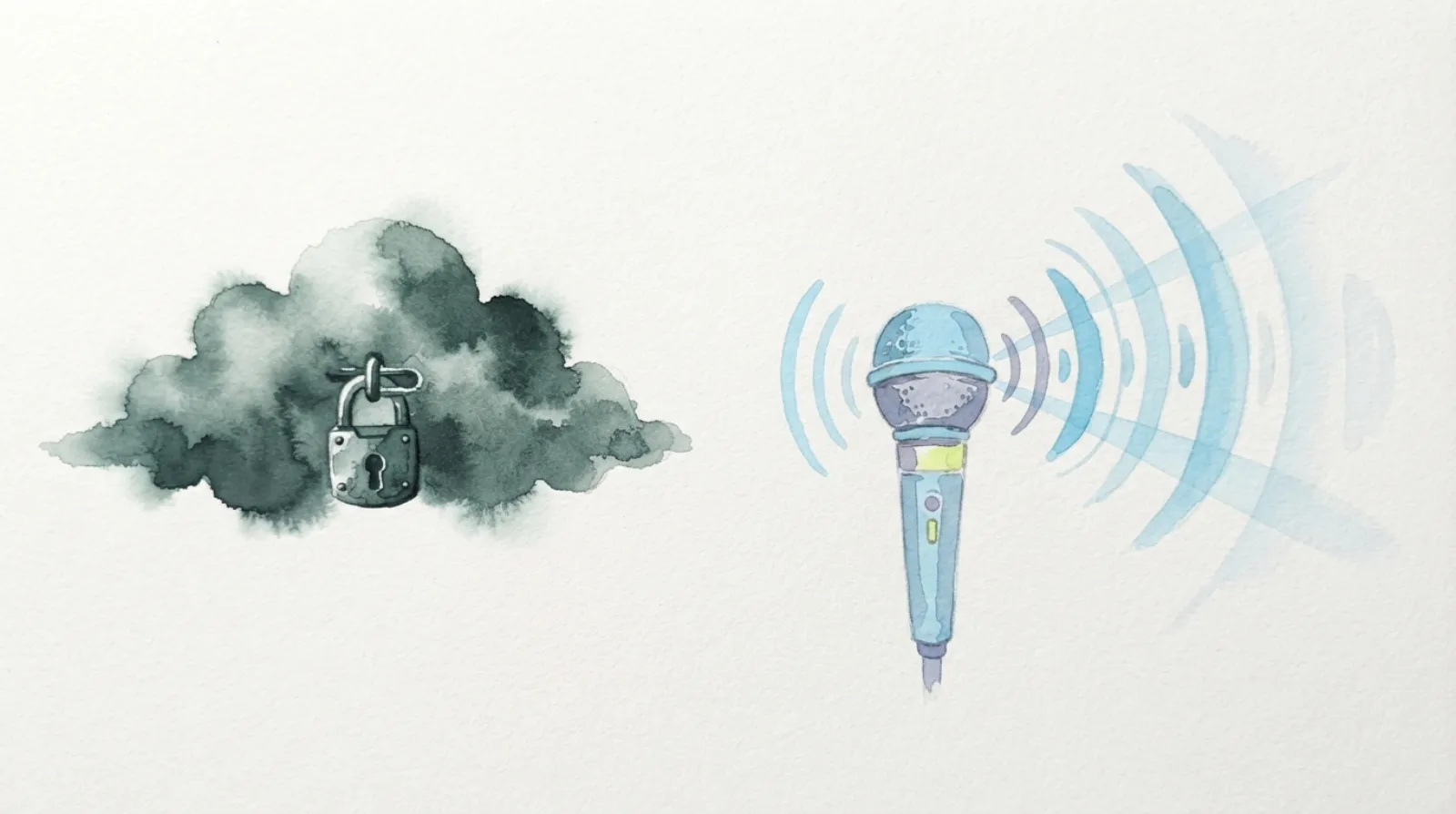
I used WisprFlow for six months. It's polished, works everywhere, and the AI cleanup genuinely saves time. At $12-15/month ($144-180/year), it's not an outrageous line item. But two things bothered me: every word I spoke left my machine, and the subscription was a recurring tax on a capability that models like Whisper and Parakeet already solve for free.
Then I found Handy.
The comparison that made me switch
| Factor | WisprFlow | Handy |
|---|---|---|
| Cost | $12-15/mo ($144-180/yr) | Free (MIT license) |
| Privacy | Cloud processing; audio sent to servers | 100% local; voice never leaves your device |
| Models | Proprietary cloud models | OpenAI Whisper + NVIDIA Parakeet V3 (GPU/CPU optimized) |
| Speed | Fast cloud inference | ~5x real-time on mid-range hardware (1 min audio → ~12 sec) |
| Platforms | Mac, Windows, iPhone, Android | Mac (Intel + Apple Silicon), Windows, Linux |
| Offline | Limited | Full offline support |
| Customization | Settings UI only | Fork it, extend it, add your own features |
| Community | Closed | 13.9k+ GitHub stars, 54 contributors, 43 releases |
What Handy actually does
Press a keyboard shortcut → speak → release → text appears in whatever field your cursor is in. That's it. No dashboard, no account, no copy-paste step. It works in your terminal, your code editor, your email, Slack, Notion, AI chat interfaces — anywhere you can type.
The workflow is deliberately minimal:
- Push-to-talk mode (default): hold the key combo while speaking, release to transcribe and paste
- Toggle mode: press once to start, press again to stop and paste
- Custom keybindings: remap to whatever fits your workflow
- System tray/menu bar indicator: always know when it's listening
Setup takes five minutes: download from GitHub or handy.computer, grant microphone and accessibility permissions, pick a Whisper model (Small or Medium recommended), set your hotkey, start transcribing.
The open-source dictation explosion
Handy isn't alone. The entire category is shifting toward local-first, open-source alternatives:
| Tool | License | Platforms | Key Differentiator |
|---|---|---|---|
| Handy | MIT | Mac/Win/Linux | Simplest push-to-talk, zero config, 5x real-time |
| FluidVoice | GPLv3 | macOS only | Built-in local AI polish (Fluid-1 model), per-app tone adaptation |
| VoiceInk | Open source | macOS (Apple Silicon) | Auto-switching enhancement modes per app, personal dictionary |
| OpenWhispr | Open source | Mac/Win/Linux | 100+ languages, MCP integration, bring-your-own-API-keys |
| FreeFlow | Open source | macOS (more coming) | Self-hosted streaming service, sub-second latency, team-ready |
| Voquill | AGPLv3 | Mac/Win/Linux | Full provider control (OpenAI, Claude, Groq, local), Tauri/Rust |
| Jarvis | Open source | macOS | Voice assistant + dictation + Mac control, chained commands |
All of these run locally by default. Your audio never leaves your machine unless you explicitly choose a cloud provider. Most are free; some offer paid tiers for convenience (hosted service, mobile app, support) — not for core capability.
Why this trend matters for operators
1. Capability is decoupled from pricing Whisper and Parakeet are open-weight models. Anyone can wrap them in an app. The "moat" for cloud dictation tools was never the transcription — it was the distribution, the polish layer, and the friction of running models locally. That friction is gone (CoreML on Apple Silicon, GPU acceleration everywhere, one-click installers).
2. Privacy is a feature, not a policy When you dictate client work, medical notes, legal drafts, or proprietary code context, "we don't store your audio" is a promise. "Your audio never leaves your device" is an architecture. For anyone handling sensitive work, the latter is the only acceptable answer.
3. No vendor lock-in If WisprFlow changes pricing, shuts down, or removes a feature you depend on, you migrate. With open source, you fork. The community maintains it. You own the stack.
4. The economics favor the operator $180/year per tool adds up across a stack (dictation + AI coding + API routing + monitoring). Free, local alternatives that do the same job mean more budget for things that actually require paid infrastructure — like frontier model access for reasoning-heavy tasks.
What I'm not saying
WisprFlow isn't "bad." Its AI auto-editing (filler removal, context-aware formatting, command mode) is genuinely impressive. If you value managed service over control, or need mobile dictation that syncs seamlessly across devices, the cloud option makes sense. The free tier (2,000 words/week) is generous enough to try it.
But for my workflow — dictating into Cursor, Claude, terminal, email, all day, often with client context — Handy wins. It's faster, free, private, and I can audit every line of code that touches my audio.
The takeaway
Before you subscribe to a cloud tool for a capability that open-weight models already solve, check if an open-source local alternative exists. The category shift toward local-first, privacy-respecting, free tooling is real and accelerating. For operators running their own stacks, it's the difference between renting capability and owning it.
---
Sources: