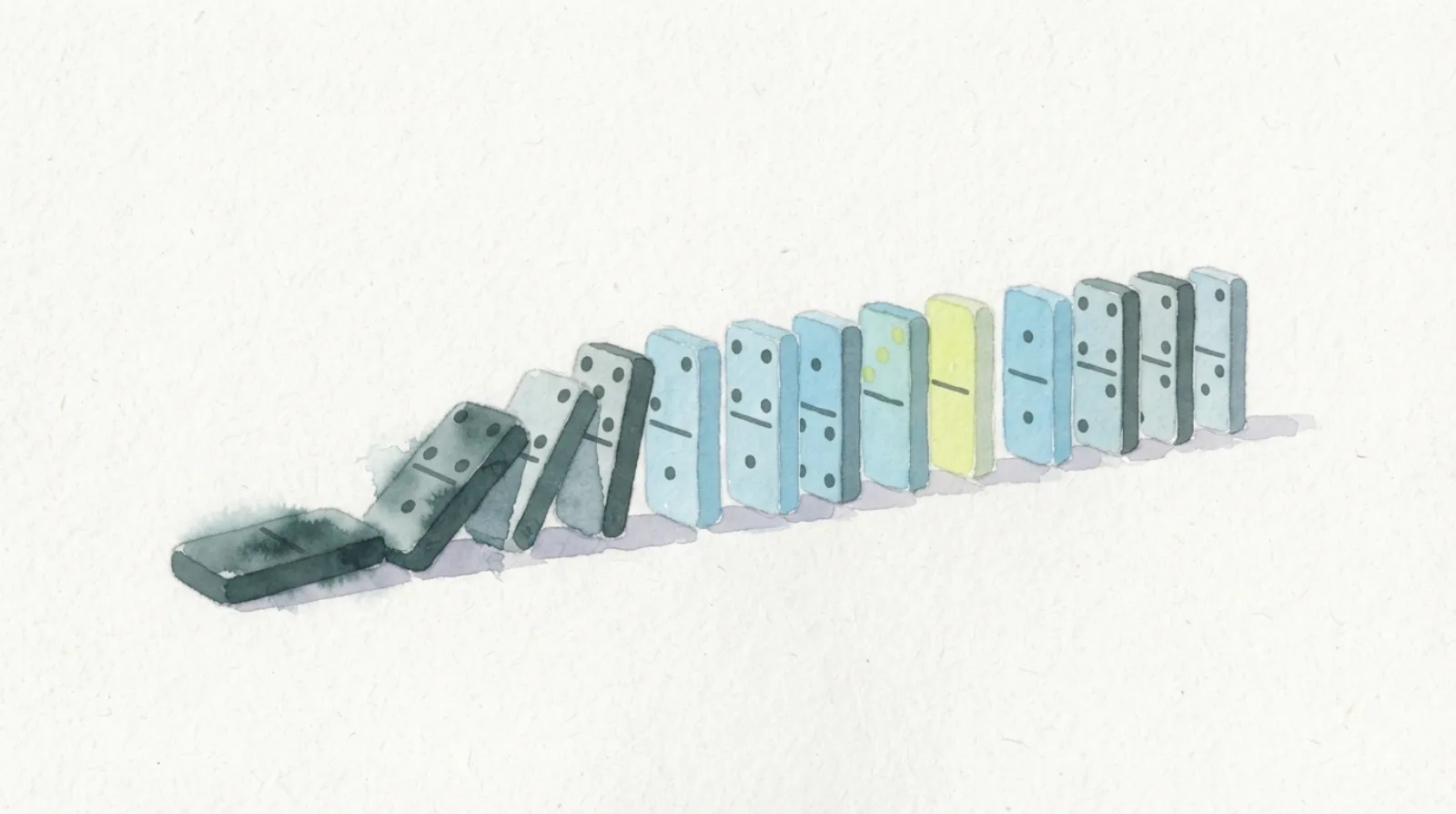
Every founder I talk to about automation starts in the same place: the impressive thing. An AI that writes proposals. A bot that answers support tickets. Something you could demo on a call. Almost none of them start where the actual money leaks out, which is the handoff. The moment where a piece of information leaves one person and is supposed to arrive at another, and doesn't.
A lead fills out the form on your website. Where does it go? In a lot of small companies, the honest answer is an inbox somebody checks when they remember. An applicant finishes a call and waits for the follow-up email that a busy person meant to send Tuesday. Nobody decided to drop these. There was no bad employee. The information just died in transit between two humans, the way it always does when the transfer depends on someone remembering.
That is the thing to automate first. Not because it is exciting. Because it fails silently, and the failure costs you the exact people you built the company to reach.
What I actually built
At our company I built the lead pipeline this way. Someone submits the web form, and three things happen without a human touching anything: the lead posts into Slack where the team sees it in real time, it lands in a Google Sheet that serves as the record, and the prospect gets an email back. I did not write the code myself. I am a VP of Operations, not a coder. I directed AI coding tools through the build and verified every step by submitting test leads and watching them arrive in all three places.
Notice what this automation does not do. It does not qualify the lead, score it, or write a clever reply. It moves one piece of information across three seams, reliably, every time. The intelligence stays with the humans. The memory moved to the machine.
I built our client onboarding email flow on the same logic. When someone enters onboarding, the emails that walk them through the process go out on schedule instead of living as a mental to-do on whoever handled the intake. Before that flow existed, the gap between "we said yes" and "they heard from us" was whatever that person's week looked like. Now it is fixed, and the person who used to carry it in their head carries nothing.
Both builds were small. Neither would demo well. Both changed something I could measure by testing it myself: a lead submitted at any hour is visible to the team and answered before anyone has logged in.
The rule underneath
The pattern is this: automate the seams between people, not the work inside one person's head.
Work inside one person's head tends to be judgment. Which lead is worth a call. What the proposal should say. How to handle the awkward client. Automating that is hard, the results need review anyway, and a competent person was already doing it fine. The seam between two people is different. It is pure transfer. There is no judgment in "this form submission should reach the sales channel." There is only the question of whether it happens every single time, and humans are the wrong tool for every single time.
Seams also fail invisibly. When a person does bad work, you see the bad work. When a handoff drops, you see nothing. The lead never complains to you. The applicant takes the other offer and you never learn there was a race. You cannot manage a failure that produces no evidence, which is exactly why these gaps survive for years in otherwise well-run companies.
So this week, instead of asking what AI could do for your business, trace one path: something enters your company from outside, a form, an application, a referral, and follow it to the moment a human acts on it. Count the handoffs. Ask, at each one, what happens if the person on the receiving end is at lunch, on vacation, or simply behind on everything. Wherever the honest answer is "it waits" or "it depends," that is your first automation. Wire that seam so the information cannot die in it.
It will not feel like an AI transformation. It will feel like plumbing. Plumbing is where the leaks are.